
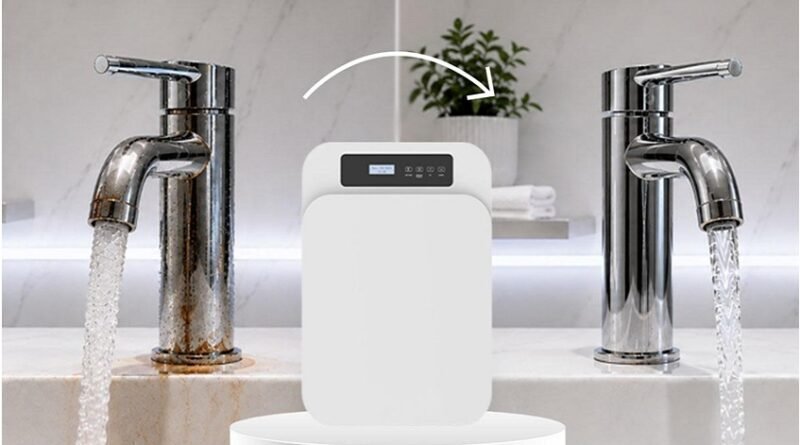
Salt-Based vs Salt-Free Water Converters Compared
If you are looking for a hard water to soft water converter, you will discover two broad options: salt-based and salt-free systems. While both are designed to address the effects of hard water, they work differently. Salt-based systems reduce the hardness-causing minerals in water, whereas salt-free systems are designed to reduce scale formation without removing calcium and magnesium, often using a process called template-assisted crystallization (TAC), where minerals are converted into micro-crystals that are less likely to stick to surfaces. The better choice depends on your water quality, the severity of hardness and what you’re hoping to improve around the house.
Hard water is one of those household problems that rarely arrives all at once. It usually starts with little things. The bathroom tap loses its shine a few days after you’ve cleaned it. The shower glass develops cloudy marks that refuse to disappear completely. Towels begin feeling a little rough, and the geyser doesn’t seem quite as efficient as it used to be.
On their own, these feel like ordinary household annoyances. Together, they often point to the same underlying issue.
Read More: Modular Kitchen Design for Real Life: Layouts That Actually Work in Busy Indian Homes
Choosing the Right System Starts With Understanding Your Water
Every home experiences hard water differently. Before selecting a hard water to soft water converter, check where the effects are most noticeable. Scale on taps, cloudy shower glass, poor soap lather and mineral deposits on appliances often indicate how widespread the problem has become.
Understanding the condition of your water first usually makes it easier to compare salt-based and salt-free water softener systems based on your home’s actual requirements rather than their feature lists.
● Salt-Based Water Softeners: How They Work
Salt-based systems work using a process known as ion exchange. As water flows through the system, specially designed resin beads attract calcium and magnesium, replacing them with sodium ions. Because the hardness-causing minerals are reduced before the water reaches your plumbing, the water flowing through taps, showers and appliances becomes softer.
For homes dealing with consistently hard water, this is often the approach people choose because it addresses the source of the problem rather than its symptoms. Most homeowners don’t notice the process itself. They notice that scale becomes less stubborn, soaps lather more easily and cleaning starts taking a little less effort. These systems also require periodic addition of salt and go through regeneration cycles, which may discharge a small amount of wastewater as part of the process. There are two types of salt-based water softeners available – manual and automatic water softeners.
The key difference between manual and automatic water softeners lies in how the regeneration process is managed. With a manual system, you need to initiate the regeneration cycle yourself by adjusting the valves, whereas an automatic water softener can start the process independently based on a timer or water usage.
-
Salt-Free Water Conditioners: How They Work
Salt-free systems approach the problem differently. Instead of removing calcium and magnesium, they are generally designed to reduce the tendency of these minerals to form stubborn scale deposits. That distinction is worth understanding because the two systems are solving similar problems in different ways. One isn’t automatically better than the other. The better choice is the one that suits your water conditions and what you expect the system to achieve.
How Salt-Based and Salt-Free Systems Differ?
Although both systems are designed to address the effects of hard water, they work in different ways.
Salt-Based Systems
- Use an ion exchange process
- Reduce calcium and magnesium
- Replace hardness-causing minerals with sodium ions
- Supply softened water throughout the plumbing system
Salt-Free Systems
- Do not remove calcium or magnesium
- Help reduce the tendency of minerals to form scale deposits
- Continue supplying water that contains the naturally occurring minerals
The choice between the two depends on the hardness of the incoming water, the level of scale formation and the outcome you expect from the system.
Water Softeners and Water Purifiers: Understanding the Difference
A water softener system and a water purifier are built for different jobs. A water softener helps reduce hardness-causing minerals such as calcium and magnesium throughout the household water supply. A water purifier, on the other hand, is used for purifying drinking water and may combine sediment filtration, activated carbon, RO, UV or UF, depending on the source water and purification requirement.
Read More: Top 5 Types of Painting to Spruce-Up your Home Décor
When choosing a hard water to soft water converter, start with the condition of your water rather than the technology. The level of water hardness, the amount of scale forming around your home and the areas being affected will usually make it easier to decide whether a salt-based or salt-free system is the better fit.